
Fiber Optical Communication

درباره سایت
آخرین مطالب
- به وبلاگ خود خوش امدید
- Analysis of A Practical CWDM System Deployment Case
- Why Not Use EDFA Amplifier in Long CATV Network?
- Why Not Using DWDM Technology to Build Your Network?
- Optical Transponder—an Important Component in WDM System
- How to Build an Economical Long-haul 500Gbps Metro Network?
- Fiber Optical Communication
- Why Do We Need Optical Transponder (O-E-O)?
- CWDM Technology—Economically Saving Fibers for Your Network
- Confused About Loss in the Long Haul DWDM Network?
امکانات وب
To meet the requirement of the fiber market, fiber optic patch cables have become more and more diverse which can be used for different applications. When choosing fiber optic patch cables, you might hear descriptions like SC to ST patch cable, LC to SC patch cable, LC to LC single mode fiber patch cable. Have you ever wondered what do LC, SC, ST stand for? Is there any difference between these types? In fact, these words refer to the different types of fiber optic coectors that are distinct from each other. The following will give the explanations for some commonly used fiber optic coectors, so that you can pick the right fiber optic coector for the sake of correct use.
Fiber Optic Coector Overview
The fiber optic coector is the device terminating the end of a fiber optic cable, which can be engaged and disengaged. In detail, it can coect the fiber optic equipment rigorously and conveniently without splicing, which is designed for maximally sending the light signal from optical transmitter to the receiver and minimizing the bad impact caused by the transmission. With the fast development of optical network, there are about 100 fiber optic coectors developed to meet the market needs, for instance, LC coector, SC coector, FC coector and ST coector which are largely used in different applications.
Different fiber optic coectors vary from the size to the application method. Here are the detail information about the four commonly used coectors for your reference.
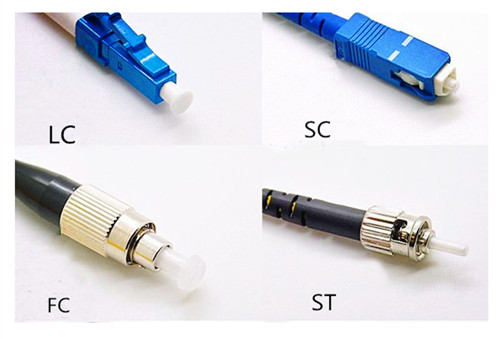
LC Fiber Optic Coector
LC fiber optic coector can be called Lucent Coector, Little Coector or Local Coector. It was invented by Bell, which makes a significant breakthrough for high density telecommunication. The coupling type of LC fiber optic coector is snap and its ferrule diameter is 1.25 mm. For its RJ-style latch clip design, it is very easy to operate. The size of LC coector is smaller than SC coector's, which attends to improve the density of optical fiber coector. As for its application, it is always used in High-density coections, SFP and SFP + transceivers, XFP transceivers. Along with the development of LC compatible transceivers and active networking components, it will keep growth in the FTTH area.
SC Fiber Optic Coector
SC fiber optic coector is rectangular and bigger than LC coector, which was developed by Nippon Telegraph and Telephone (NNT) in Japan. It can also be called Subscriber Coector, Square Coector or Standard Coector. Its ferrule diameter is 2.5 mm, twice as long as LC fiber optic coector's. As for its application, it is very convenient to plug and pull without any revolve. With the property of high temperature resistance and oxidation resistance, it is usually coected to the lateral interface of the transmission equipment. Compared with other coectors, it is not very expensive and works easily and fast, which would be a good choice for most applications, such as, Datacom and telecom, GPON, EPON and GBIC.
FC Fiber Optic Coector
FC fiber optic coector is round and threaded that is also referred to as Ferrule Coector. It was also developed by NNT, with the purpose of being applied for single-mode optic fiber and polarization-maintaining optic fiber. Furthermore, it was the first fiber optic coector with a ceramic ferrule and the ferrule diameter is 2.5mm, as long as of SC fiber optic coector. However, FC coector is becoming less common and mostly replaced by SC and LC coector for its vibration loosening and insertion loss.
ST Fiber Optic Coector
ST fiber optic coector was designed by AT amp; T shortly after the arrival of the FC coector. The word ST refers to Straight Tip. It is probably still the most popular coector for multimode networks, like most buildings and campuses, which has a bayonet mount and a long cylindrical 2.5 mm ceramic (usually) or polymer ferrule to hold the fiber. For its spring-loaded structure, you'd better to check whether it is seated properly before use. If there is still high loss, you can try to recoect it to see if it makes a difference.
Conclusion
It's clear that all of the coectors mentioned in this paper have a place in the market. Except these coectors, there are many other popular types, such as, MPO coector, MU coector and MT-RJ coector. These types of coectors are distinct from each other, designed for different applications. Hence, you should select the right coector for your network, so that there will be no coection problems when installing the complicated fiber equipment.
برچسب: picking the right dog,picking the right college,picking the right watermelon,picking the right career,picking the right ruing shoe,picking the right mattress,picking the right credit card,picking the right car,picking the right foundation,picking the right golf ball,
نویسنده: پارسا رضایی